





How Michigan is using AI in its strategy to compete in the Talent Wars
Submitted by rgordon on Thu, 03/05/2026 - 16:21

Thursday, March 5, 2026
By showcasing innovative, collaborative, and technology-enabled solutions, the initiative surfaces practical strategies for preparedness, response, and adaptation across five key domains: emergency management, cybersecurity, supply chain resilience, sustainability, and workforce development.
This case study follows that model by providing an actionable framework to help public sector organizations break down silos, build stronger networks, and enhance their ability to anticipate and withstand future shocks.
Introduction
People move to a community, not just a state, and that distinction shapes how Michigan is approaching its workforce challenges. The state is developing resources that job seekers will find valuable, including a Career Portal, generating positive coverage around quality of life and career opportunities with a collaborative spirit and a willingness to adapt. This case study illustrates how state governments are not bound by past precedents but can instead be driven by future opportunities, using innovative approaches and technologies like AI.
The challenge: Demographic shifts and talent wars
The State of Michigan faces a dual challenge: demographic shifts and intensifying competition for talent. After decades of population stagnation and decline, the state is projected to see slow population growth over the next decade. The population has shifted from a young, higher-fertility base to an older, lower-fertility one over the past century.[1] Additionally, the state suffers a residual reputation for poor quality of life and few career opportunities, despite significant diversification in these areas. This stems from the state’s long-standing economic dependency on the auto industry, which creates a perception that other industries and opportunities are limited, despite trends to the contrary.[2]
Furthermore, growing industries, such as advanced manufacturing and healthcare, compete for talent in the broader “Talent Wars,” as described in a 2025 Development Counsellors International (DCI) report. With changing demographics, industries are experiencing an unprecedented labor shortage, and the workforce landscape is more competitive than ever.[3]
Faced with an aging population, persistent misconceptions about economic diversity, and intensifying competition for talent, Michigan has had to rethink its approach to workforce development. In response, the state has embraced artificial intelligence (AI) as a transformative tool to build a resilient, future-ready workforce. This essay examines how Michigan’s strategic utilization of AI—particularly through its Career Portal and public-private partnerships—has enabled the state to better prepare for talent and transformation.
The response: Statewide collaboration and technical innovation to attract and retain talent
In 2022, the State of Michigan and the Michigan Economic Development Corporation (MEDC), an Accredited Economic Development Organization, kicked off the nation’s largest talent attraction and retention strategy. Established in 2022, MEDC’s Talent Action Team was the nation’s first public-private state talent coalition. MEDC collaborated across the talent ecosystem with partners in PreK-12 systems, higher education, workforce development, local governments, and industry. It initially focused on aligning talent ecosystem partners to support strategic sectors within the advanced manufacturing industry, including the EV/mobility and semiconductor sectors.[4] The Talent Action Team was named a Gold Winner of the 2025 Excellence in Economic Development Awards for Talent Development & Retention and a Silver Winner for Public-Private Partnership by the International Economic Development Council in August 2025.[5]
To help fill the workforce pipeline for these initiatives and employment opportunities, the Michigan state government launched a national talent attraction campaign, “You Can in Michigan,” in 2023. The campaign supported the messaging component of the state’s talent strategy with national TV ads/video content, testimonials, and paid digital media ads on social and search.[6] The campaign motivated its audience - out-of-state, national talent - to take action and pursue career opportunities within the state. In 2023, MEDC launched a job board, the Michigan Career Portal (https://michigancareerportal.org/). The job board features an AI-powered match profile tool that recommends open positions based on job seekers’ skills, experience, education, and certifications. MEDC partnered with SmartJobBoard, a leading job board software provider, to build the Michigan Career Portal using AI to provide fast and efficient parsing and matching technology, as well as filters for location, company, and industry categories, making the Career Portal an efficient resource for job seekers to find open positions across Michigan that align with their preferences.
Outcomes and benefits realized
The Michigan Career Portal’s AI capabilities include semantic search and skills-based matching, which analyze job seekers’ profiles—including their work experience, education, certifications, and stated interests—to recommend highly relevant job opportunities. The filtering system allows users to narrow results by location, company and industry, while the AI engine continuously learns from user behavior to improve recommendations. This personalization reduces the time burden for job seekers and increases the likelihood of successful matches, contributing to higher engagement and application rates. The platform’s design also emphasizes accessibility by promoting skills-based hiring, helping to reduce bias and opening doors for non-traditional candidates.
In an industry flooded with tools that can make the job search experience feel overwhelming, MEDC prioritized AI tools that optimize user experience and, as a result, improve perceptions of Michigan as a place to live and work. Below is quantifiable data on the outcomes and benefits realized.
- An internal May 2025 survey of 26,033 registered users of the Michigan Career Portal showed that 59% of respondents reported that they have identified job opportunities in Michigan using the Career Portal. (Interview with Spencer Lucker, Director of Strategic Talent Initiatives, 8.1.25)
- The average click rate for a job posting application button on the Michigan Career Portal site is 15%, compared to an average click rate of 5% on other career sites.[7]
- Average engagement time on site is 2 minutes, 33 seconds per active user for the Michigan Career Portal, compared to the 1 minute, 19 seconds on other career sites. (Interview with Spencer Lucker, Director of Strategic Talent Initiatives, 8.1.25)
Job listings on the Michigan Career Portal are sourced through APIs and web scraping tools developed in partnership with SmartJobBoard. The job posting data is compiled from publicly available resources, including employer websites. Normalization protocols manage different data formats, such as varying job title structures, location tags, and employment categories, to maintain consistency and accuracy across listings. Although MEDC does not have data sharing agreements directly with employers, these tools pull job postings in real time and update the portal daily. This distinguishes the Michigan Career Portal from national job boards, where job openings are often dependent on employer-paid placements and may not reflect active openings.
It is worth emphasizing that MEDC’s strategy and execution are regularly measured for outcomes and positive user experience through customer feedback, surveys, and portal analytics. This review process leads to the development of tactics and resources that address job seekers’ needs, as well as continuous improvement to meet Michigan’s population and workforce challenges.
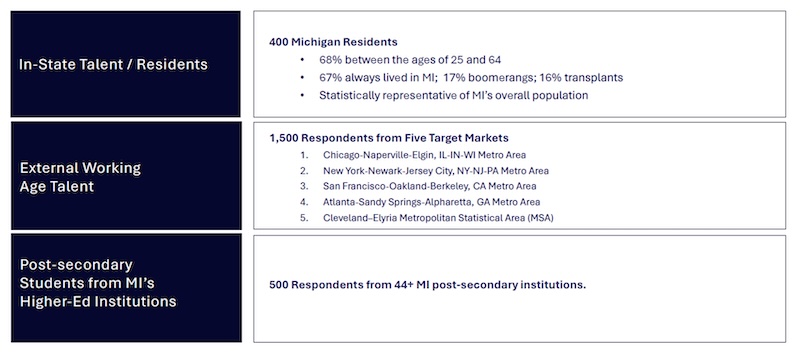
The impacts of MEDC’s talent attraction and retention strategy are evidenced by the Michigan Talent Perception Study in 2023 and 2025, assisted by DCI. The following groups are the priority talent audiences for Michigan, included in this Study.
Lessons learned and critical success factors
The following four lessons and critical success factors could benefit other state governments looking to replicate the actions taken by Michigan for workforce transformation:
- Leverage public-private collaboration for strategic workforce development. Michigan’s success has been rooted in its ability to foster collaboration between the private sector, higher education, primary and secondary education, workforce development, and government stakeholders. The creation of the Talent Action Team—the nation’s first public-private state talent coalition—demonstrates how aligning interests across sectors can lead to more targeted and effective workforce strategies. Michigan’s public-private collaboration was facilitated through a structured engagement process led by the MEDC’s Talent Solutions division members.[8] This included a mix of in-person summits, virtual roundtables, and ongoing meetings and discussions among all stakeholders. Other state governments may consider establishing a coalition of industry, government, and education partners to co-design and implement workforce initiatives. Michigan’s experience shows that it is also beneficial to focus on specific strategic sectors (e.g., EV/mobility, semiconductors) to ensure alignment with economic development goals and future labor market needs.
- Use AI to personalize and streamline talent matching. A centralized portal helps convert interest into applications. Moreover, Michigan’s deployment of an AI-powered career portal significantly improved job seeker experience and employer outcomes by matching talent with opportunities based on skills and preferences. Other state governments may consider partnering with a reliable software provider to implement semantic search and skills-based matching. It is also beneficial to employ real-time data updates from employer sites to maintain the relevance and accuracy of job listings and prioritize user experience to increase engagement.
- Design workforce resilience as part of modernization strategy. Michigan’s experience also highlights a broader lesson for government leaders: technology strategies alone do not create workforce transformation. Across large public sector modernization programs, the conversation often begins with AI platforms, data infrastructure, and digital tools—but it ultimately returns to the workforce responsible for sustaining them. Workforce resilience is emerging as a critical dependency of enterprise modernization. As governments introduce AI-enabled platforms and new digital services, institutions must simultaneously invest in skills development, governance literacy, and operating models that allow civil servants to continuously adapt to new ways of working. States seeking to replicate Michigan’s success should therefore view workforce strategy not as a downstream change management activity, but as core infrastructure that enables technology investments to deliver lasting value.
- Build a unified brand and messaging strategy to attract talent. Michigan’s “You Can in Michigan” campaign filled a perception vacuum by promoting the state’s quality of life and career opportunities through a cohesive, multimedia strategy. This is an important complement to traditional marketing campaigns that target businesses as an attraction and retention audience. Other state governments may consider launching a national, multimedia campaign with consistent branding across platforms that are complementary to existing business and destination marketing campaigns. Equally important is backing the messages with data-driven insights to measure impact and refine targeting.
What’s next
Among state efforts to explore or pilot AI-powered job matching platforms and skills-based hiring tools, Michigan’s approach deserves recognition as a replicable model for talent attraction and retention that other state governments might fruitfully adopt.
The Michigan Career Portal connects talent with the jobs of the future while supporting economic and workforce development goals that are deeply integrated into Michigan’s economic strategy. Along with the accompanying “You Can in Michigan” campaign and broader talent solutions strategy, it will help to fill openings and support the state government’s economic strategy.
Complementary to MEDC’s existing talent strategy and campaign, Michigan is actively expanding its AI-driven workforce strategy through a comprehensive initiative, “AI and the Workforce Plan,” released in May 2025 by the Michigan Department of Labor and Economic Opportunity (LEO). This is an addendum to the 2024 Michigan Statewide Workforce Plan and is built on three pillars: (1) Invest in skill development for the AI economy, (2) Understand and guide the workforce landscape for knowledge and skilled trade workers, and (3) Enable businesses to adapt to the AI economy.[9] This effort has the potential to expand further the opportunities for Michigan’s workforce to remain in the state and find success through economic transitions.
With a strong statewide foundation laid, the work must continue by investing in and developing local community development organizations that are important partners for Michigan’s success. It is necessary to support the physical and social infrastructure at the local level, localizing the live-work-play messaging for Michigan’s campaign tools.
[1] Michigan Center for Data and Analytics. “Michigan Statewide Population Projections through 2050.” April 2024. https://www.michigan.gov/mcda/reports/michigan-statewide-population-projections-through-2050-report
[2] James M. Hohman and Chase Slasinski. “Michigan’s Auto Industry Matters Less to the State Workforce.” June 12, 2019. Mackinac Center for Public Policy. https://www.mackinac.org/michigans-auto-industry-matters-less-to-the-state-workforce
[3] Development Counsellors International. “Talent Wars 2025.” May 22, 2025. https://aboutdci.com/research/talent-wars-2025
[4] Stefanie Pohl. “This Just In: MEDC’s Talent Action Team gains global recognition in Most Innovative Companies list.” March 19, 2024. Michigan Economic Development Corporation. https://www.michiganbusiness.org/press-releases/2024/03/fast-company-innovative-companies
[5] International Economic Development Council. “International Economic Development Council Announces Winners of the 2025 Excellence in Economic Development Awards.” August 20, 2025. https://www.iedconline.org/news/2025/08/20/iedc-updates/international-economic-development-council-announces-winners-of-the-2025-excellence-in-economic-development-awards
[6] This can be evidenced by its official YouTube (https://www.youtube.com/@YouCanInMichigan_/) and Instagram (https://www.instagram.com/youcaninmichigan/) channels, as well as its main campaign website (https://themichiganlife.org/).
[7] Kaitlyn Levinson. “Michigan turns to AI to spruce up its workforce development efforts.” April 10, 2025. Route Fifty. https://www.route-fifty.com/workforce/2025/04/michigan-turns-ai-spruce-its-workforce-development-efforts/404464
[8] The Talent Action Team is the name of a group of stakeholders that MEDC collaborates with. MEDC’s Talent Solutions division is the department at MEDC that initiated the development of the Talent Action Team and leads the ongoing collaboration and development of programs to support the talent attraction, retention, and workforce strategies for the Talent Action Team.
[9] Michigan Department of Labor and Economic Opportunity. “AI and the Workforce Plan will create good-paying jobs, invest in workforce and enhance Michigan’s economic growth.” May 29, 2025. https://www.michigan.gov/leo/news/2025/05/29/ai-and-the-workforce-plan-will-create-jobs-invest-in-workforce-and-enhance-economic-growth