





A Practical Guide for AI Use by Public Sector Leaders — and Why This Matters Now More Than Ever
Submitted by rgordon on Tue, 03/24/2026 - 14:03
Tuesday, March 24, 2026
Within five days, one million people had used it. Within two months, 100 million had. No technology in history had achieved such rapid adoption. And for those of us working in the federal, state, and local government space, the questions arrived just as fast: What is this? Should we allow it? How do we govern it? What does it mean for our workforce, our data, and the citizens we serve?
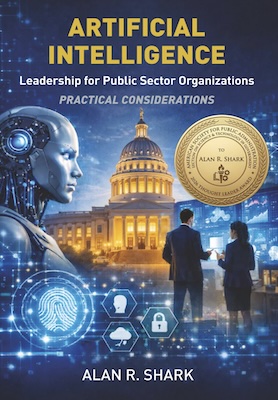
Those questions are exactly what drove me to write Artificial Intelligence: Leadership for Public Sector Organizations — Practical Considerations. Over the past four years, I have had the privilege of working alongside public administrators, technology leaders, elected officials, and frontline employees as they have grappled with AI's promise and peril. This book is my attempt to gather the most important lessons from that journey — drawn from commentaries I have published in Government Technology, Route Fifty, StateTech, FedTech, and other outlets — into one practical, accessible resource.
Government Is Not the Private Sector — And That's the Point
One of the arguments I make early in the book is that public-sector AI cannot be evaluated using the same lens as private-sector AI. When Amazon's recommendation algorithm fails, you see an irrelevant product suggestion. When a government algorithm fails, someone might lose housing assistance, be wrongly flagged by law enforcement, or have a permit application unjustly denied. The stakes are not merely financial — they involve rights, dignity, and trust in democratic institutions.
Throughout the book, I emphasize that government operates under unique constraints: transparency requirements, equity obligations, due process protections, democratic accountability, and resource limitations that make billion-dollar AI investments unthinkable for most local agencies.
Five Parts, One Coherent Journey
The book is organized into five parts that trace the arc of AI's arrival and maturation in public service. Part I covers the Foundations — what AI actually is, the five questions every administrator must ask before adopting it, how it functions as a thought processor, and what emotional intelligence in machines means for human governance. Part II turns to Governance and Accountability: auditing AI, the risks of agentive AI in local government, cybersecurity challenges, and the emerging problem of "AI fatigue" — the real exhaustion that sets in when the pace of change outstrips an organization's capacity to adapt.
Part III examines Organizational Leadership — the impact of AI on public procurement, the emerging role of the Chief Artificial Intelligence Officer at the state and local level, and the "tribes and tribulations" that arise when new technologies threaten existing power structures. Part IV digs into Policy, Regulation, and Implementation: generative AI's expanding role in search, the debate between guardrails versus guiderails, shadow AI in government agencies, workforce displacement fears, and responsible AI piloting. Finally, Part V addresses Sustainability and Emerging Challenges — AI's enormous energy demands, the growing power of voice interfaces, rising costs, workforce readiness, AI in public education, and the accountability gaps that state and federal preemption laws can create.
Wisdom Earned Over Four Years in the Trenches
My perspective comes from over two decades of working directly with public-sector technology leaders through the Public Technology Institute, from my work at George Mason University's Schar School of Policy and Government, and from my many years as co-chair of the National Academy of Public Administration's Standing Panel on Technology Leadership. I have seen what works, what fails, and what keeps administrators up at night.
I deliberately kept each chapter to three to five pages — because I know how busy the people I am writing for truly are. But do not mistake brevity for shallowness. These chapters distill real lessons: the shock of discovering employees were already using ChatGPT before any policy existed; the messy realities of data classification and governance; the political complexity of AI procurement; and the very human cost of constant technological disruption. Each chapter was written in the moment, as events unfolded, and that timeliness is part of what makes them useful.
Who This Book Is For — And What I Hope You Take Away
I wrote this book for practitioners: city managers and CIOs navigating vendor pitches and budget pressures, department heads wrestling with workforce concerns, elected officials explaining AI policy to skeptical constituents, and students entering a field where AI literacy is no longer optional. Whether you are just beginning your AI journey or have been experimenting for several years, my goal is to give you the kind of grounded, values-driven guidance that is too often missing from conversations dominated by tech industry voices.
AI is not optional, not distant, and not simple. But it is navigable — if we lead with wisdom, stay grounded in democratic values, and learn from those who have gone before us. I hope this book serves as a trusted companion on that journey.