





Improving The Effectiveness of Government Financial Oversight Through AI
Submitted by rgordon on Mon, 04/06/2026 - 13:27
Monday, April 6, 2026
Government financial oversight stands at an inflection point, enabled by artificial intelligence and other emerging technologies. As agencies manage increasingly complex digital financial systems, traditional audit methods—anchored in sampling, manual review, and documentation checks—can be supplemented by modern analytics approaches, implemented early in the payments cycle and tracked through the audit stage. Such strategies can enable agencies to address emerging risks to transparency, accountability, and public trust by effectively safeguarding taxpayer resources.
This takes on high importance given that in 2024, 18 of 24 federal agencies received clean audit opinions, yet the Government Accountability Office (GAO) estimates the federal government loses $233 billion to $521 billion annually to fraud. The contrast indicates significant opportunities to improve how financial management processes that culminate in audits relate to financial outcomes.
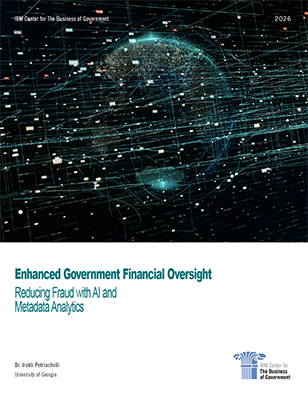
A new report from the IBM Center, Enhanced Government Financial Oversight: Reducing Fraud with AI and Metadata Analytics, by Dr. Irakli Petriashvili with the University of Georgia, provides a timely and practical roadmap for enhancing financial integrity in ways that can improve federal audit processes. Drawing on deep analysis of government financial practices, reporting standards, and transaction data, the report highlights a critical need: current agency audit processes can still be limited by sampling-based audit approaches, a gap that can be addressed by data and analytics that track fraud throughout payment lifecycles.
The report demonstrates the untapped power of supplementing audits with metadata for financial analysis—information automatically captured for every federal transaction. When paired with machine learning, metadata can enable analysts and auditors to analyze entire populations of transactions, uncover anomalies invisible to traditional methods, and detect fraud more accurately and at large scale. Applying machine learning to such metadata can bring orders of magnitude improvement in detecting fraudulent activity, relative to samplings methods used by most current audit processes. Experimental evidence presented by the author shows that AI-driven analytics reveal fraud patterns that would otherwise remain undetected.
The capabilities of machine learning approaches in fraud detection present an opportunity for federal audit methodology reform. The ability to analyze complete transaction populations using metadata characteristics offers a path toward more comprehensive and effective government oversight, without abandoning established audit standards and procedures.
The recommendations offered—including enabling metadata analysis as part of federal financial management and audit processes, launching AI pilot programs within agencies, and redefining oversight objectives to foster real-time protection for taxpayer funds—provide government leaders with a clear, actionable path forward. They reflect an evolution in government oversight, aligning practices with today’s digital realities.
This report advances the IBM Center’s longstanding mission to strengthen public-sector performance through technology and innovation. Previous reports include Enhancing Government Payment Integrity: Leveraging AI and Other Emerging Technologies; and A Prepared Federal Government: Preventing Fraud and Improper Payments in Emergency Funding.
The evidence presented in this study suggests that federal oversight agencies can prioritize the development and implementation of technology-enhanced audit methodologies that complement traditional approaches. Through such methodological evolution, federal financial auditing can achieve its mission of ensuring accountable and transparent use of public funds in an increasingly complex governmental financial environment. By embracing metadata intelligence and AI-enabled oversight, agencies can enhance oversight and audit processes to strengthen fraud detection and accountability—and in doing so, to build greater public trust in the stewardship of government resources